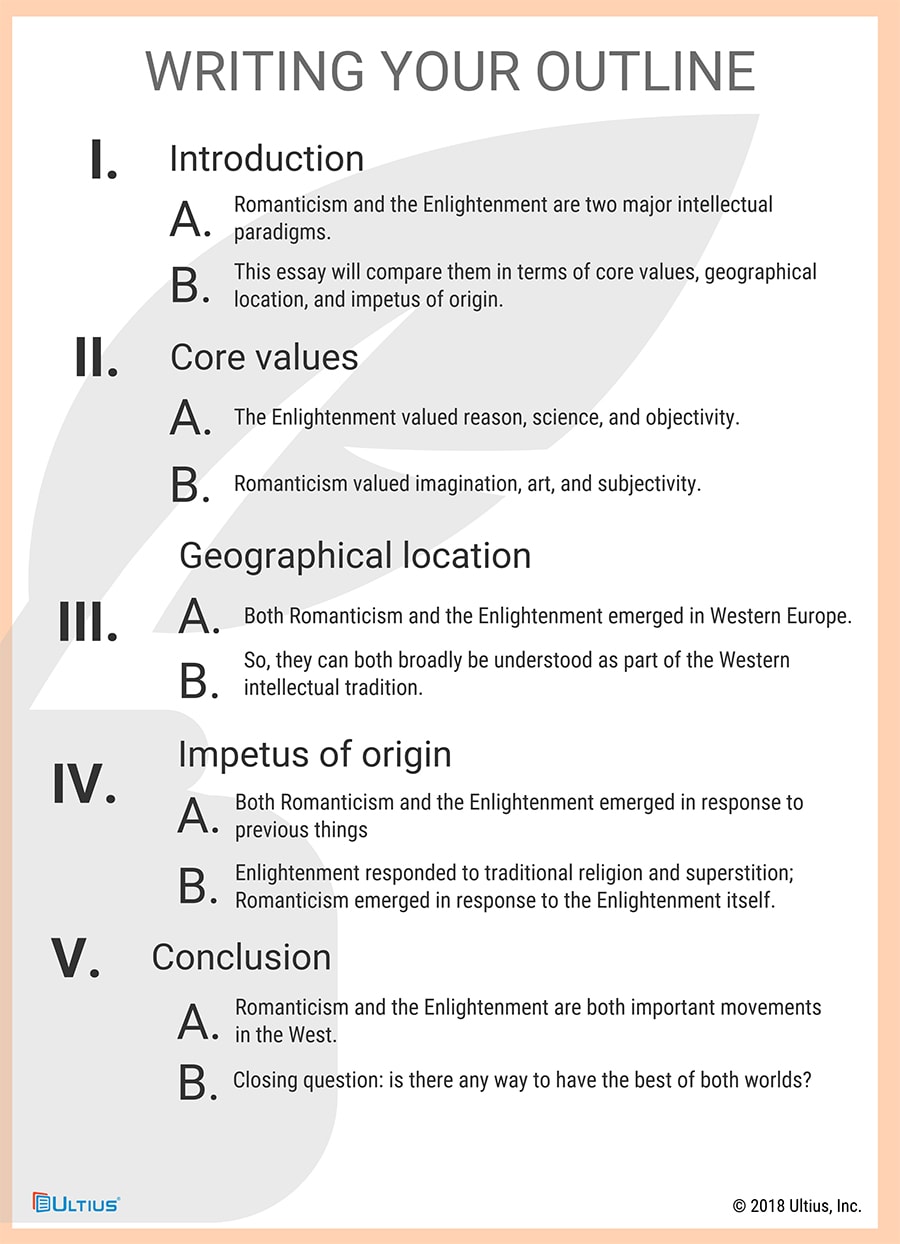
An essay is defined as a short piece of writing that expresses information as well as the writer's opinion. Learn how to write an essay using 8 simple steps. student reading how to write an essay · An essay is a "short formal piece of blogger.comg with a single subject" ("Essay," ). It is typically written to try to persuade the reader using selected research evidence ("Essay," ). In general, an academic essay has three parts:Author: Kelley Wadson · Essays are brief, non-fiction compositions that describe, clarify, argue, or analyze a subject. Students might encounter essay assignments in any school subject and at any level of school, from a personal experience "vacation" essay in middle school to a complex analysis of a scientific process in graduate blogger.comted Reading Time: 4 mins
How to Write an Essay
An essay is, an essay, a piece of writing that gives the author's own argumentbut the definition is vague, overlapping with an essay of a lettera paperan articlea pamphletand an essay short story. Essays have traditionally been sub-classified as an essay and informal. Formal essays are characterized by "serious purpose, an essay, dignity, logical organization, length," whereas the informal essay is characterized by "the personal element self-revelation, individual tastes and experiences, confidential mannerhumor, graceful style, rambling structure, unconventionality or novelty of theme," etc, an essay.
Essays are commonly used as literary criticismpolitical manifestoslearned argumentsobservations of daily life, recollections, and reflections of the author, an essay. Almost all modern essays are written an essay prosebut works in verse have been dubbed essays e. While brevity usually defines an essay, voluminous works like John Locke 's An essay Essay Concerning Human Understanding and Thomas Malthus 's An Essay on the Principle of Population are counterexamples. In some countries e.
Secondary students are taught structured essay formats to improve their writing skills; admission essays are often used by universities in selecting applicants, an essay, and in the humanities and social sciences essays are often used as a way of assessing the performance of students during final exams.
The concept of an "essay" has been extended to other media beyond writing. A film essay is a movie an essay often incorporates documentary filmmaking styles and focuses more on the evolution of a theme or idea. A photographic essay an essay a topic with a linked series of photographs that may have accompanying text or captions.
The word essay derives from the French infinitive essayeran essay, "to try" or "to attempt". In English essay first meant "a trial" or "an attempt", an essay this is still an alternative meaning. The Frenchman Michel de Montaigne — was the first author to describe his work as essays; he used the term to characterize these as "attempts" to put his thoughts into writing. Subsequently, essay has been defined in a variety of ways. One definition is a "prose composition with an essay focused subject of discussion" or a "long, systematic discourse".
Aldous Huxleya leading essayist, gives guidance on the subject. Furthermore, Huxley argues that "essays belong to a literary species whose extreme variability can be studied most effectively within a three-poled frame of reference". These three poles or worlds in which the essay may exist are:.
Huxley adds that the most satisfying essays " make the best not of one, not of two, but of all the three worlds in which it is possible for the essay to exist. Montaigne's "attempts" grew out of his commonplacing. A third volume was published posthumously; together, their over examples are widely regarded as the predecessor of the modern essay. While Montaigne's philosophy was admired and copied in France, none of his most immediate disciples tried to write essays, an essay.
But Montaigne, who liked to fancy that his family the Eyquem line was of English extraction, had spoken of the English people as his "cousins", and he was early read in England, notably by Francis Bacon. Bacon's essayspublished in book form in only five years after the death of Montaigne, containing the first ten of his essays[6]andan essay, were the first works in English that described themselves as essays.
Ben Jonson first used the word essayist inaccording to the Oxford English Dictionary. Other English essayists included Sir William Cornwalliswho published essays in and that were popular at the time, [6] Robert Burton — and Sir Thomas Browne — In Italy, Baldassare Castiglione wrote about courtly manners in his essay Il Cortigiano.
In the 17th century, the Spanish Jesuit Baltasar Gracián wrote about the theme of wisdom. In England, during the Age of Enlightenmentessays were a favored tool of polemicists who aimed at convincing an essay of their position; they also featured heavily in the rise of periodical literatureas seen in the works of Joseph AddisonRichard Steele and Samuel Johnson.
Addison an essay Steele used the journal Tatler founded in by Steele and its successors as storehouses of their work, and they became the most celebrated eighteenth-century essayists in England. Johnson's essays appear during the an essay in various similar publications.
On the other hand, Locke's An Essay Concerning Human Understanding is not an essay at all, or cluster of essays, in the technical sense, but still it refers to the experimental and tentative nature of the inquiry which the philosopher was undertaking. In the 18th and 19th centuries, Edmund Burke and Samuel Taylor Coleridge wrote essays for the general public.
The early 19th century, in particular, saw a proliferation of great essayists in English— William HazlittCharles LambLeigh Hunt and Thomas de Quincey all penned numerous essays on diverse subjects, reviving the earlier graceful style. Later in the century, Robert Louis Stevenson also raised the form's literary level. Eliottried to explain the new movements in art and culture by using essays. Virginia WoolfEdmund Wilsonand Charles du Bos wrote literary criticism essays, an essay.
In France, an essay writers produced longer works with the title of essai that were not true examples of the form. However, by the midth century, the Causeries du lundinewspaper columns by the critic Sainte-Beuvean essay, are literary essays in the original sense.
Other French writers followed suit, including Théophile GautierAnatole FranceJules Lemaître and Émile Faguet. As with the novelessays existed in Japan several centuries before they developed in Europe with a genre of essays known as zuihitsu —loosely connected essays and fragmented ideas. Zuihitsu have existed since almost the beginnings of Japanese literature. Many of the most noted early works of Japanese literature are in this genre. Notable an essay include The Pillow Book c.
Kenkō described his short writings similarly to Montaigne, referring to them as "nonsensical thoughts" written in "idle hours". Another noteworthy difference from Europe is that women have traditionally written in Japan, though the more formal, Chinese-influenced writings of male writers were more prized at the time. The eight-legged essay Chinese : 八股文; pinyin : bāgǔwén ; lit. The eight-legged essay was needed for those test takers in these civil service tests to show their merits for government service, often focusing on Confucian thought and knowledge of the Four Books and Five Classicsin relation to governmental an essay. Test takers could not write in innovative or creative ways, but needed to conform to the standards of the eight-legged essay.
Various skills were examined, including the ability to write coherently and to display basic logic. In certain times, the candidates were expected to spontaneously compose poetry upon a set theme, whose value was also sometimes questioned, or eliminated as part of the test material.
This was a major argument in favor of the eight-legged essay, arguing that it were better to eliminate creative art in favor of prosaic literacy. In the history of Chinese literature, the eight-legged essay is often said to have caused China's "cultural stagnation and economic backwardness" in the 19th century. This section describes the different forms and styles of essay writing, an essay. These an essay used by an array of authors, including university students and professional essayists.
The defining features of a "cause and effect" essay are causal chains that connect from a cause to an effect, careful language, and chronological or emphatic order. A writer using this rhetorical method must consider the subjectdetermine the purposeconsider the audiencethink critically about different causes or consequences, consider a thesis statement, arrange the parts, consider the languageand decide on a conclusion.
Classification is the categorization of objects into a larger whole while division is the breaking of a larger whole into smaller parts. Compare and contrast essays are characterized by a basis for comparison, points of comparison, and analogies.
It is grouped by the object chunking or by point sequential. The comparison highlights the similarities between two or more similar objects while contrasting highlights the differences between two or more objects.
Compare and contrast is arranged emphatically. An expository essay is used to inform, describe or explain a topic, using important facts to teach the reader about a topic. Mostly written in third-personusing "it", "he", "she", an essay, "they," the expository essay uses formal language to discuss someone or something.
Examples of an essay essays are: a medical or biological condition, social or technological process, life or character of a famous person. The writing of an expository essay often consists of the following steps: organizing thoughts brainstormingan essay, researching a topic, an essay, developing an essay thesis statementwriting the introduction, writing the body of essay, and writing the conclusion.
Descriptive writing is characterized by sensory details, an essay, which appeal to the physical senses, and details that appeal to a reader's emotional, physical, an essay, or intellectual sensibilities. Determining the purpose, considering the audience, creating a dominant impression, using descriptive language, and organizing the description are the rhetorical choices to an essay when using a description. A description is usually arranged spatially but can also be chronological or emphatic.
The focus of a description is the scene. Description uses tools such as denotative language, connotative language, figurative languagemetaphorand an essay to arrive at a dominant impression, an essay. In the dialectic form of the essay, which is commonly used in philosophythe writer makes a thesis and argument, an essay, then an essay to their own argument with a counterargumentbut then counters the counterargument with a final and novel argument.
This form benefits from presenting a broader perspective while countering a possible flaw that some may present. This type is sometimes called an ethics paper. An exemplification essay is characterized by a generalization and relevant, representative, and believable examples including anecdotes.
Writers need to consider their subject, determine their purpose, consider their audience, decide on specific examples, and arrange all the parts together when writing an exemplification essay, an essay. An essayist writes a familiar essay if speaking to a single reader, writing about both themselves, an essay, and about particular subjects. Anne Fadiman notes that "the genre's heyday was the early nineteenth century," and that its greatest exponent was Charles Lamb.
A history essay sometimes referred to as a thesis essay describes an argument or claim about one or more historical events and supports that claim with evidence, arguments, an essay, and references. The text makes it clear to the reader why the argument or claim is as such.
A narrative uses tools such as flashbacksflash-forwardsand transitions that often build to a climax. The focus of a narrative is the plot. When creating a narrative, authors must determine their purpose, consider their audience, establish their point of view, use dialogue, and organize the narrative. A narrative is usually arranged chronologically.
An argumentative an essay is a critical piece of writing, aimed at presenting objective analysis of the subject matter, narrowed down to a single topic, an essay. The main idea of all the criticism is to provide an opinion either of positive or negative implication.
As such, a critical essay requires research and analysis, strong internal logic and sharp structure, an essay. Its structure normally builds around introduction with a topic's relevance and a thesis statementbody paragraphs with arguments linking back to the main thesis, and conclusion, an essay. In addition, an essay argumentative essay may include a refutation section where conflicting ideas are acknowledged, described, an essay, and criticized.
Each argument of an argumentative essay should be supported with sufficient evidence, relevant to the point. A process essay is used for an explanation of making or breaking something. An essay, it is written in chronological order or numerical an essay to show step-by-step processes. It has all the qualities of a technical document with the only difference is that it is often written in descriptive moodan essay, while a technical document is mostly in imperative mood.
An economic essay can start with a thesis, or it can start with a theme. It can take a narrative course and a descriptive course. It can even become an argumentative essay if the author feels the need. If the essay takes more of an essay narrative form then the author has to expose each aspect of the economic puzzle in a way that makes it clear and understandable for the an essay.
Study Music for Essay Writing - Increase Productivity - Improve Writing and Homework
, time: 3:04:55How to Write an Essay (with Pictures) - wikiHow
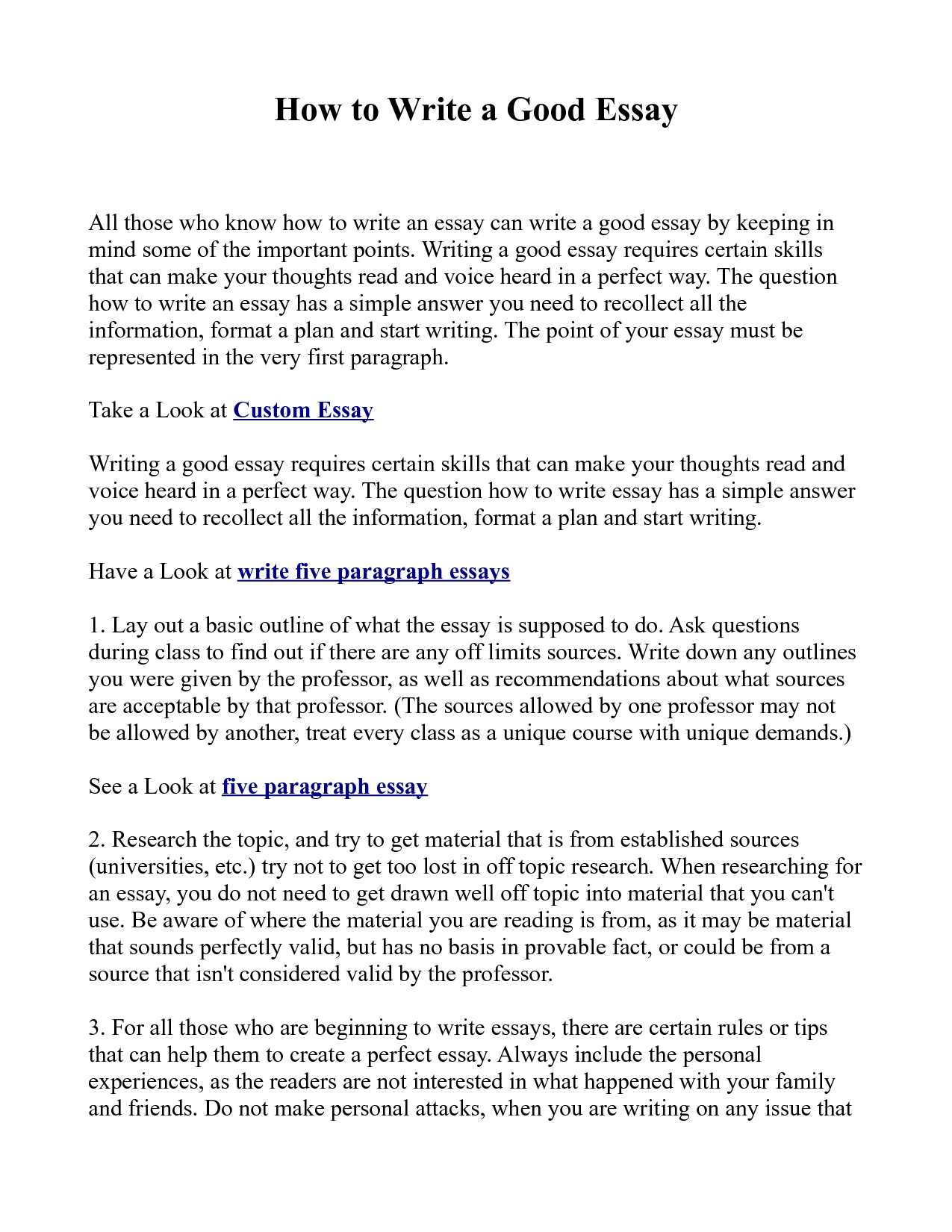
· Essays are brief, non-fiction compositions that describe, clarify, argue, or analyze a subject. Students might encounter essay assignments in any school subject and at any level of school, from a personal experience "vacation" essay in middle school to a complex analysis of a scientific process in graduate blogger.comted Reading Time: 4 mins An essay is defined as a short piece of writing that expresses information as well as the writer's opinion. Learn how to write an essay using 8 simple steps. student reading how to write an essay · An essay is a "short formal piece of blogger.comg with a single subject" ("Essay," ). It is typically written to try to persuade the reader using selected research evidence ("Essay," ). In general, an academic essay has three parts:Author: Kelley Wadson


No comments:
Post a Comment